
A well-furnished apartment needs more than attractive furniture. The layout must work for the people staying there, essential supplies must be ready for each arrival, and the finished listing must show what is actually in the unit.
If you are looking for a holiday home furnishing package Dubai owners can use, start by defining the work—not by choosing a sofa. The sequence below helps you separate Dubai Department of Economy and Tourism (DET) criteria from comfort and styling choices. It also gives you a way to decide whether to coordinate the setup yourself or ask a manager to handle it.
Confirm the permit and classification before buying furniture
DET says apartments and villas must be registered and approved before they are listed as holiday homes. Its permit guidance identifies supporting documents, and the permit must be displayed in the unit. Check the current permit process and the Holiday Homes user guide through the Dubai Department of Economy and Tourism (DET) website before you set a launch date.
Your unit’s applicable classification matters when you plan furnishings. DET’s criteria include minimum bedroom and studio floor areas, bed dimensions and other furnishings that vary by classification. A checklist for one apartment may not be right for another. Keep a copy of the criteria you are working from, then check the completed unit against them before photography or listing.
Treat the points below as a planning guide, not a replacement for the current DET documents. Where a criterion varies by unit type or classification, verify the requirement for your particular apartment.
2. Plan the layout and sleeping arrangements
Begin with a simple floor plan. Measure each room, mark doors and windows, and note where people will walk when beds, tables and luggage are in place. Choose beds that fit the actual room while leaving comfortable circulation and usable storage.
Do not set an advertised sleeping capacity just by counting the places where a mattress could fit. Check the applicable DET classification criteria, the room layout and the sleeping arrangements you can genuinely provide. A sofa bed or extra bed should not appear in a listing unless it is part of the finished setup and the description accurately explains it.
For each sleeping space, ask:
- Can someone move around the bed and open the wardrobe without shifting furniture?
- Is there a useful place for luggage and personal items?
- Do curtains or blinds offer appropriate privacy and light control?
- Does the listing clearly describe the beds that are actually there?
This is especially useful when furnishing a compact studio or an apartment with an unusually shaped bedroom. A clear layout usually serves the unit better than filling every open space.
3. Set up bedrooms and bathrooms for repeat use
Choose beds, bedside surfaces and storage with daily use and cleaning in mind. Before buying decorative pieces, confirm that the core inventory can be maintained between stays.
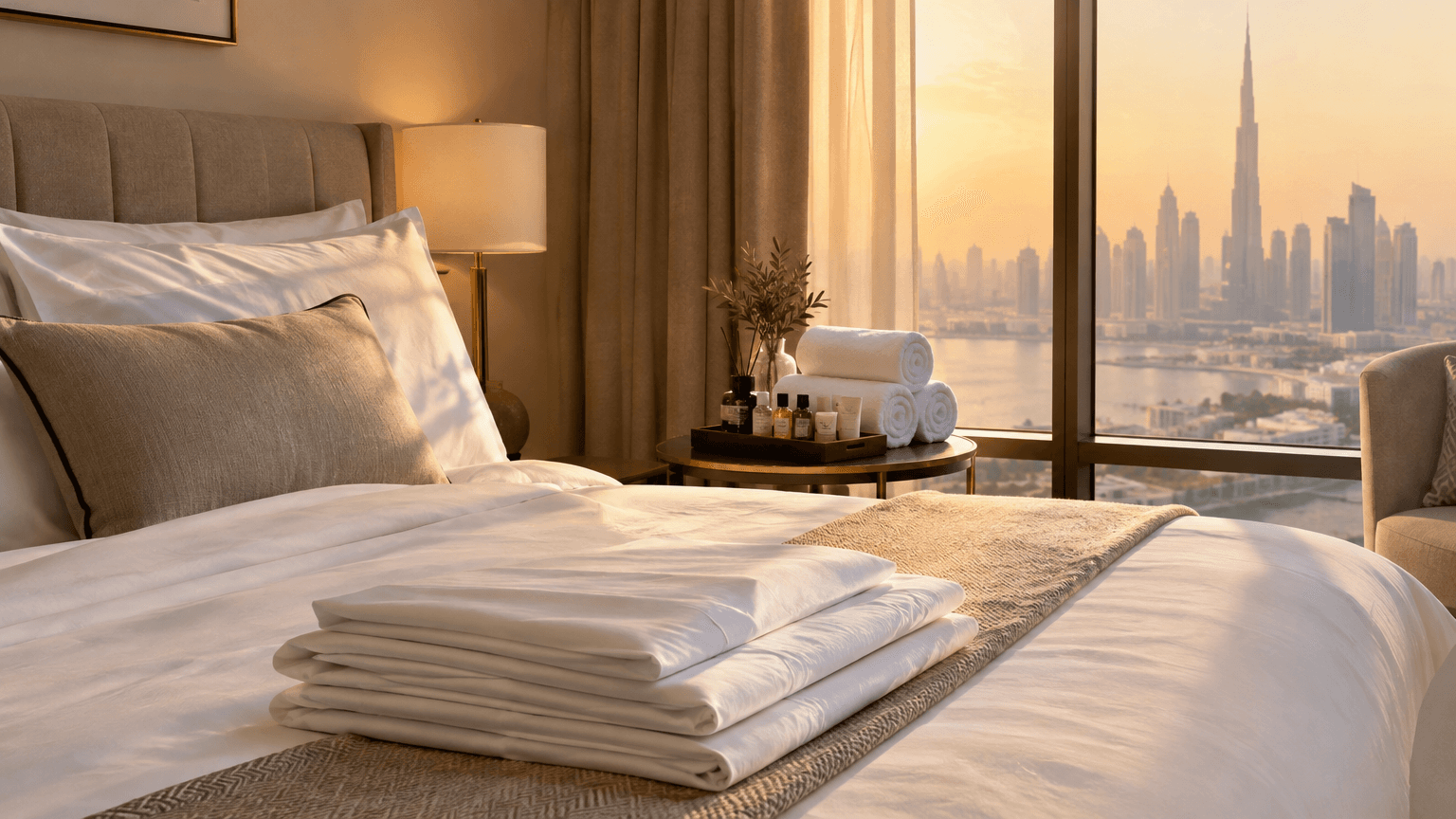
DET’s Holiday Homes guide specifies two sets of bed sheets and pillow covers for each bed, and two sets of towels for each room. It also lists a bath mat and towel holder. Check the latest guide and applicable classification criteria as you prepare your inventory. Keep spare sets organised so that a missing or damaged item can be identified during a changeover.
For comfort, consider whether your chosen pillows, duvet, curtains and lighting make the room easy to use. These are practical furnishing decisions; do not treat every styling choice as a DET rule. In the bathroom, make space for towels and personal items without crowding the room. The guide also lists bathing and personal-hygiene accessories such as soap and shampoo, so include these in your supply plan rather than remembering them only on launch day.
4. Equip the kitchen for the unit you have
Work from the DET criteria first. The guide’s kitchen criteria include a sink and draining board, microwave, cooking utensils and tableware. Requirements for appliances such as an oven, fridge or dishwasher vary by unit type and classification. Verify the list that applies to your apartment rather than assuming every kitchen needs the same equipment.
Then make the space practical. Check that the number and type of plates, glasses and utensils suit the sleeping arrangements you plan to advertise. Store items where they are easy to find, and avoid filling cupboards with equipment that does not work or cannot be cleaned easily.
Before launch, test each appliance you intend to provide. If a feature appears in your photographs or listing, it should be present and working when the apartment is handed over.
5. Prepare information, access and safety items
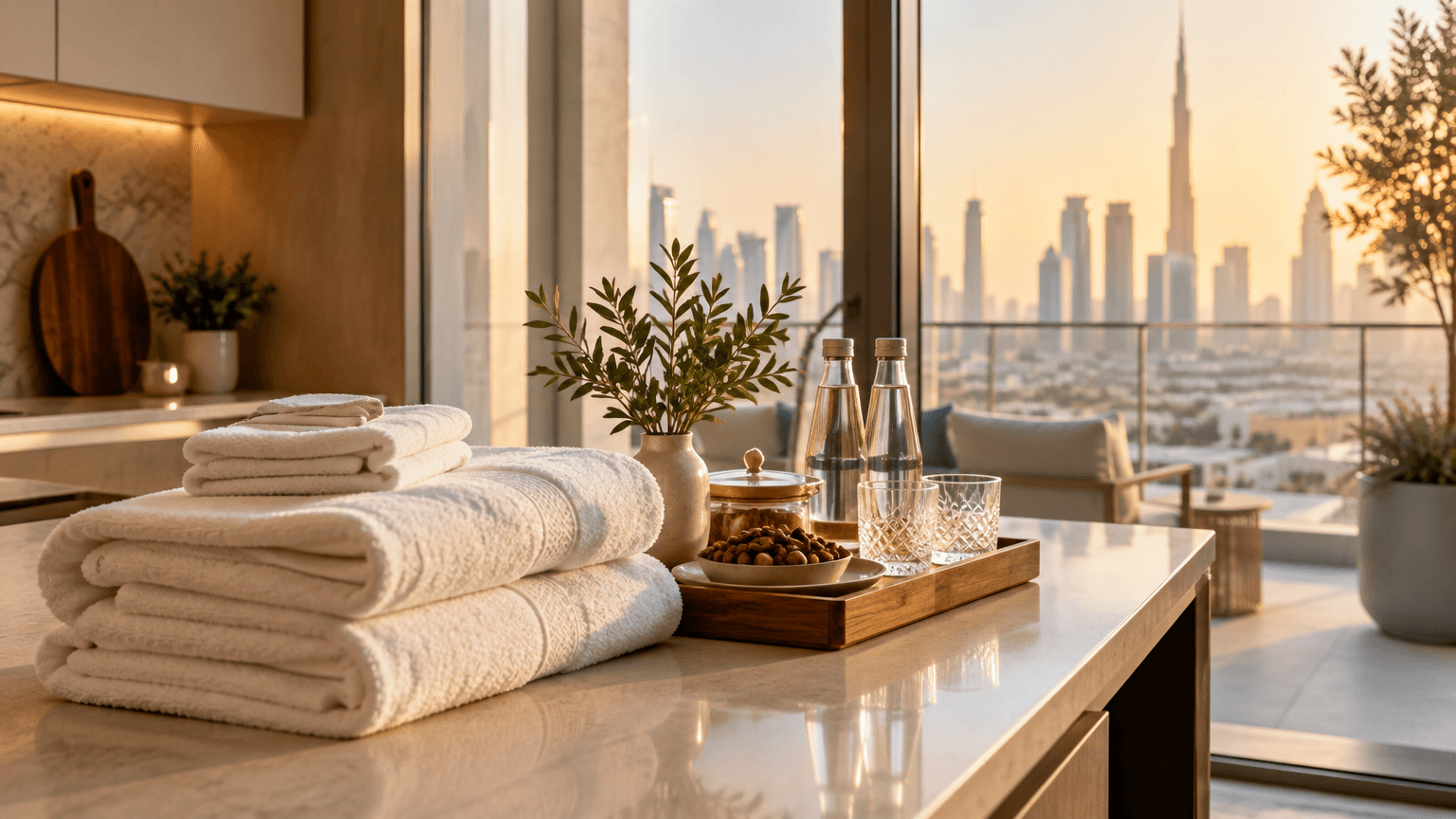
A welcome basket is an optional hospitality choice. Clear information is more important. DET’s guide includes a visitor guide covering building services, nearby public facilities, unit contents and DET complaint contact details. Prepare this for the actual building and unit rather than relying on a generic template. If you want to add a small welcome item, plan how it will be checked and replenished.
The guide also lists a first-aid kit, emergency procedures in Arabic and English, emergency contact details, emergency tools, and a peep-hole or intercom among unit criteria. Check the current wording and your applicable classification when you complete the safety review. DET lists an entrance smart lock under its criteria; check the latest guide and relevant building and security requirements before selecting or installing one.
Make access instructions match the final access method. A lock is only useful if the people responsible for arrivals, cleaning and maintenance know how it works and what to do if it fails.
6. Test Wi-Fi and decide which technology helps
Wi-Fi is listed as a main unit criterion in DET’s guide. Arrange the connection early enough to test it throughout the apartment, including the sleeping areas. Keep clear connection instructions in the unit and make sure the person managing changeovers can confirm the network is working.
Do not confuse Wi-Fi with a smart TV requirement. DET’s classification table specifies a colour TV with remote in the master bedroom for deluxe apartments and villas; Wi-Fi is listed separately. A smart TV, streaming access and a simple Wi-Fi instruction card can be useful setup choices, but you should not describe a smart TV as a universal DET requirement.
If you provide connected devices, test their controls and remove any personal accounts before the apartment goes live.
7. Check the finished apartment, then photograph it
Photography comes after the setup—not while boxes, missing lamps or temporary furniture are still in place. Photograph each room in daylight where possible. Show the real bed layout, kitchen, bathrooms, storage and any amenities you plan to mention. Keep the images accurate rather than styling the space in a way that cannot be maintained.
Photography is an editorial and listing-accuracy step, not a DET furnishing standard. Before the shoot, do a pre-launch walkthrough:
- Test the Wi-Fi, appliances, lights and access method.
- Verify emergency information and the visitor guide.
- Count the clean linen and towel sets and check where spares are stored.
- Remove personal items and check cupboards and drawers.
- Confirm that every photographed item will remain in the apartment.
- Review the proposed listing description against the finished rooms and sleeping arrangements.
This walkthrough is also a useful handover record if someone else will operate the apartment.
Two-part holiday home setup Dubai checklist
Keep regulatory checks and optional additions on separate lists. It makes purchasing decisions clearer and helps prevent a welcome item or design preference from being mistaken for a requirement.
DET criteria to verify
- Registration, approval, permit documents and permit display before listing.
- Classification-specific floor areas, beds and furnishings.
- Bed linen, pillow covers, towels, bath mat and towel holder.
- Applicable kitchen equipment and Wi-Fi.
- Visitor guide, hygiene accessories, safety information and equipment.
- Entrance access criteria and any relevant building or security requirements.
Practical comfort additions
- Clear walking space, usable storage and easy-to-maintain furnishings.
- Organised spare inventory and a plan to replenish consumables.
- Simple instructions for Wi-Fi, appliances and access.
- Optional welcome items and technology that you can reliably maintain.
- Accurate photographs taken after the full setup is complete.
Furnish it yourself or choose a managed setup?
Furnishing it yourself can suit an owner who has time to measure rooms, source items, coordinate deliveries and assembly, track inventory, arrange checks and prepare the final handover. It gives you direct control over each selection, but you will also need to manage substitutions, missing items and follow-up work.
A managed setup can bring those tasks into one coordinated scope. Depending on the arrangement, a manager may help plan the layout, source and install furnishings, check inventory, coordinate styling, cross-check the unit against applicable criteria, test the setup and prepare it for photography and operations. Management may also cover the ongoing work of checking supplies and arranging replenishment. Confirm exactly what is included rather than assuming every service covers every step.
If you are comparing holiday home packages Dubai providers describe, request a written scope that answers:
- Who measures the unit and confirms the furnishing plan?
- Who sources items, coordinates trades and handles assembly?
- Who checks the current DET criteria and who is responsible for permit steps?
- Which items, appliances, linens and consumables are included or excluded?
- Who tests the finished apartment and records any outstanding work?
- Who manages replacements and replenishment after launch?
These questions make a DIY plan and a managed proposal easier to assess on the same basis. They also make the handover clearer for whoever will operate the home.
A finished apartment should be easy to check, maintain and describe honestly. Start with the applicable DET guidance, build a workable layout, complete the inventory, test the unit and only then photograph it. If you would like help coordinating the setup and ongoing holiday home management, explore our services or contact us to talk to LuxeStay.
Frequently asked questions
What should a holiday home furnishing package in Dubai include?
Ask for a written scope covering layout planning, furniture and equipment sourcing, delivery and assembly, linen and towel inventory, applicable DET criteria checks, technology testing, styling, photography preparation and handover. Check exclusions and who handles replacements and replenishment after launch.
Can I decide sleeping capacity by adding more beds?
No. Start with the actual room layout and the DET classification criteria that apply to your unit, including relevant floor-area and bed specifications. Advertise only the sleeping arrangements provided in the finished apartment.
Does DET require a smart TV in every holiday home?
Do not treat a smart TV as a universal DET requirement. The DET guide lists Wi-Fi separately and specifies a colour TV with remote in the master bedroom for deluxe apartments and villas. Check the current guide for your classification before buying equipment.
Should I photograph the apartment before all furnishings arrive?
Wait until the setup is complete. Test the items you plan to show, then photograph each room and its real sleeping arrangements. The listing should accurately reflect the apartment as it will be maintained.
What should I check before choosing a managed setup?
Confirm who handles purchasing, delivery, assembly, inventory, applicable criteria checks, permit-related tasks, final testing and handover. Get included items, exclusions, responsibilities and ongoing replenishment arrangements in writing.